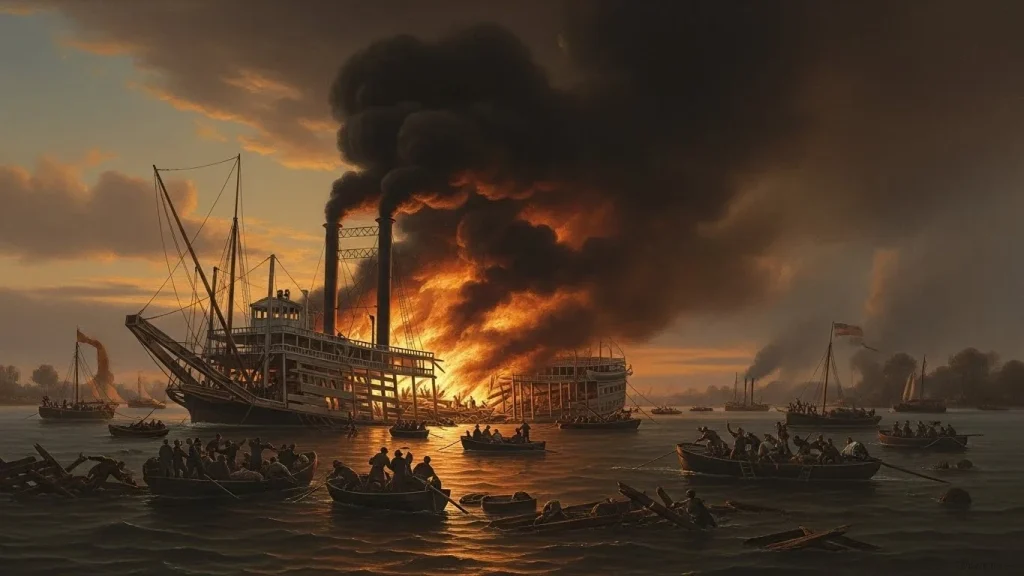
Beneath the broad, winding path of the American story flows a darker current a tale not of triumph, but of unimaginable loss, forgotten by time. Most know of the Titanic, but America’s own deadliest maritime tragedy lies sunk in the muddy silt of history. This is the story of the Sultana steamboat disaster a catastrophe born from the ashes of civil war, fueled by human failing, and executed by the relentless, muddy river running wild. To truly stand on those overcrowded decks and feel the tremble before the blast, you must go beyond the footnotes. For the full, human scope of this tragedy, I urge you to read the definitive account in my book, The Muddy River’s Hunger: The Sultana Tragedy.
The Sultana Steamboat Disaster: A Prelude to Tragedy
A Longing for Home
As I, Catherine Howard, pieced together from military records and pension files, the Sultana steamboat disaster began not with a spark, but with a desperate longing for home. It was April 1865. The Civil War was finally over. As a result, thousands of Union soldiers many mere skeletons recently released from the hellscapes of Andersonville and Cahaba prisons flooded river ports, their only thought a northward journey.
The Fatal Temptation of Greed
Into Vicksburg stepped the sidewheel steamboat Sultana, captained by J. Cass Mason. Lured by a U.S. government contract that paid by the head, Mason made a fateful decision. He intentionally packed the boat far beyond its legal limit of 376. By the time it left Memphis, over 2,300 souls were aboard. Every passage and every cranny held a soldier dreaming of Indiana, Ohio, or Michigan. Ultimately, this greed-driven calculus set a ticking clock. However, as I argue in my book, the river itself was preparing its own catastrophic role in the drama.
A Muddy River Running in Wrath
A River Transformed
To understand the final act, you must understand the stage. In my research, I became fixated on the condition of the Mississippi that spring. It was not the placid, brown highway of lore. Instead, torrential rains and northern melts had swollen its banks for weeks, transforming it into a furious giant a muddy river running at a raging, debris-choked flood stage.
The River as an Active Threat
This muddy river running with such violent force, required immense power to navigate against. Consequently, the Sultana’s overtaxed, hastily patched boilers strained under the pressure. Furthermore, that thick, sediment-laden water created dangerous inconsistencies in the boilers’ water levels. Therefore, the river, in its raw, elemental power, was not a passive setting. As I detail in my chapter, The Current’s Conspiracy, it acted as an active and ominous accomplice, stressing the ship’s frail heart at every turn.
The Night the Sky Rained Fire and Iron
The Apocalyptic Blast
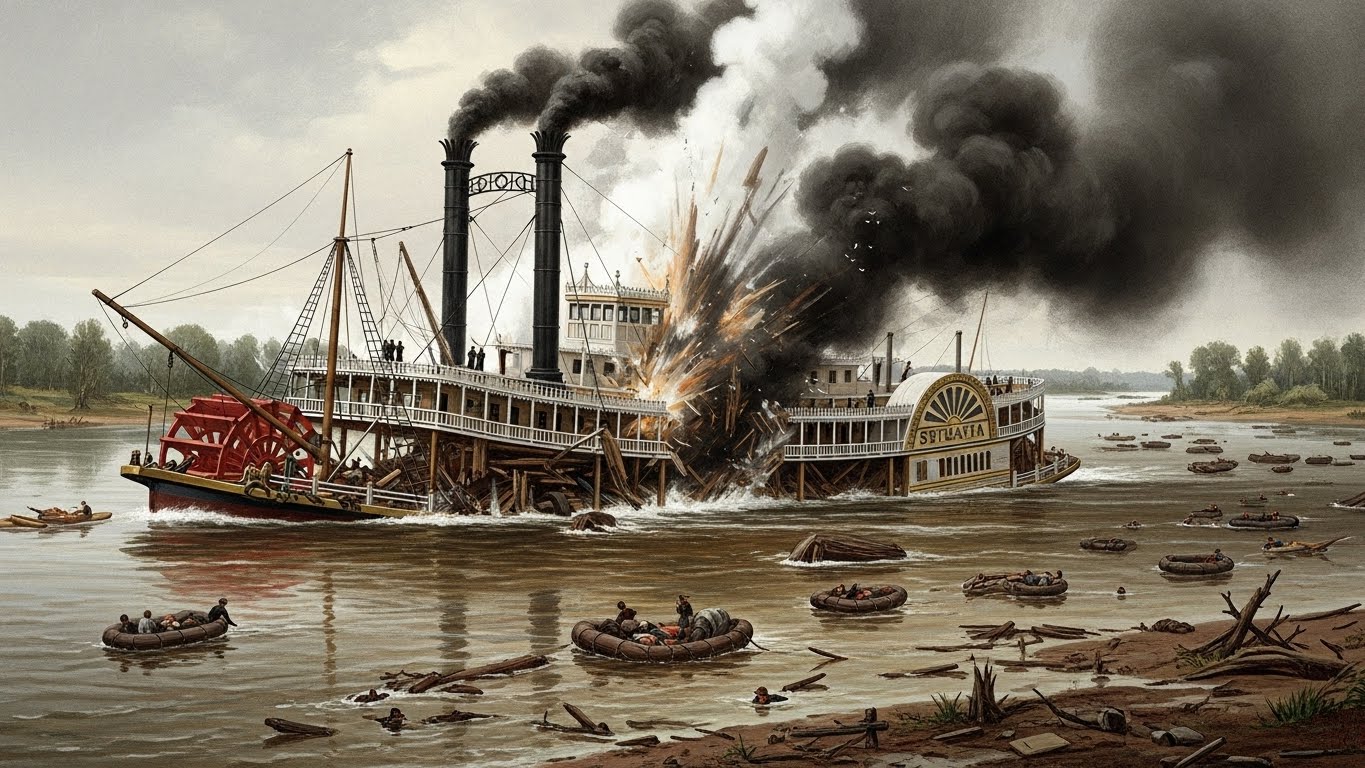
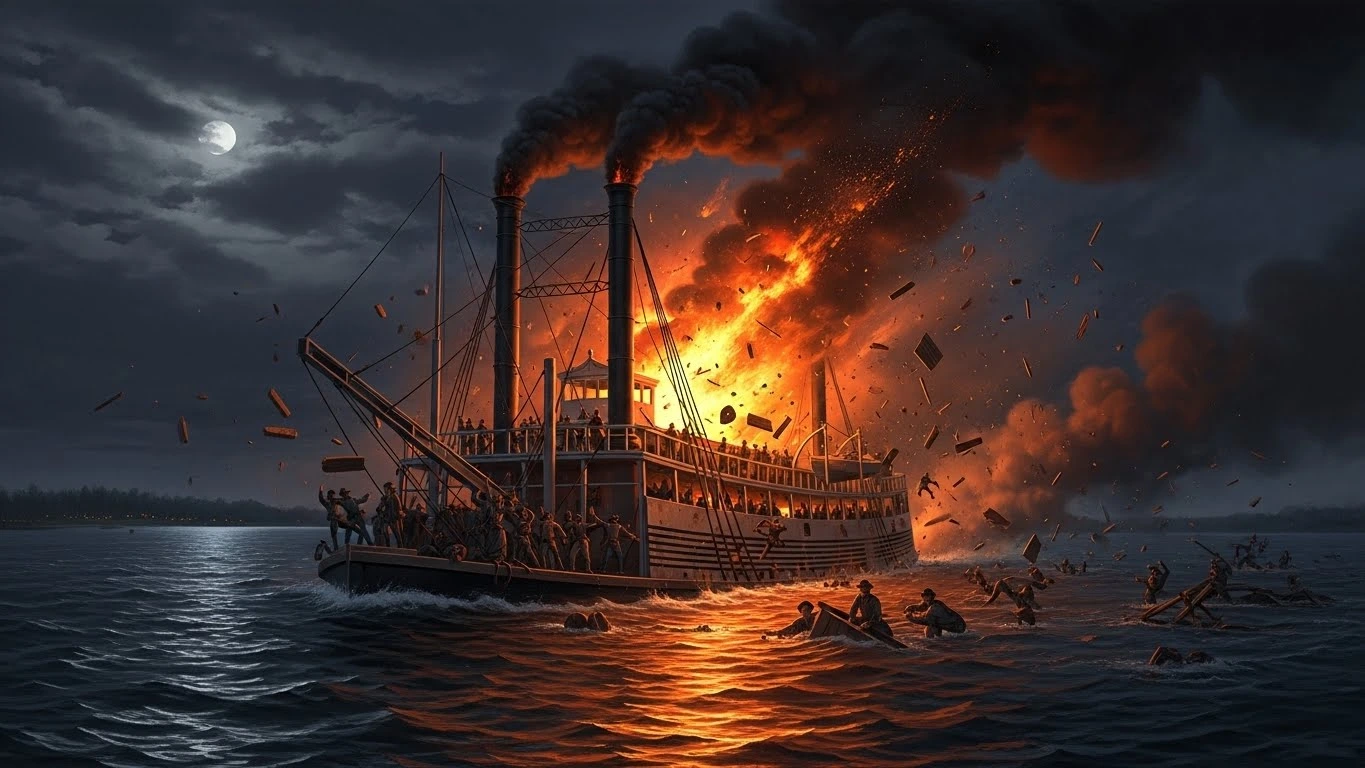
The climax, which I reconstructed from dozens of survivor interviews, arrived with apocalyptic suddenness. At 2 a.m. on April 27, 1865, seven miles north of Memphis, three of Sultana’s four boilers exploded. The blast echoed for miles. Immediately, the center of the boat vanished in a geyser of scalding steam, shredded wood, and red-hot metal.
A Cruel Choice in the Water
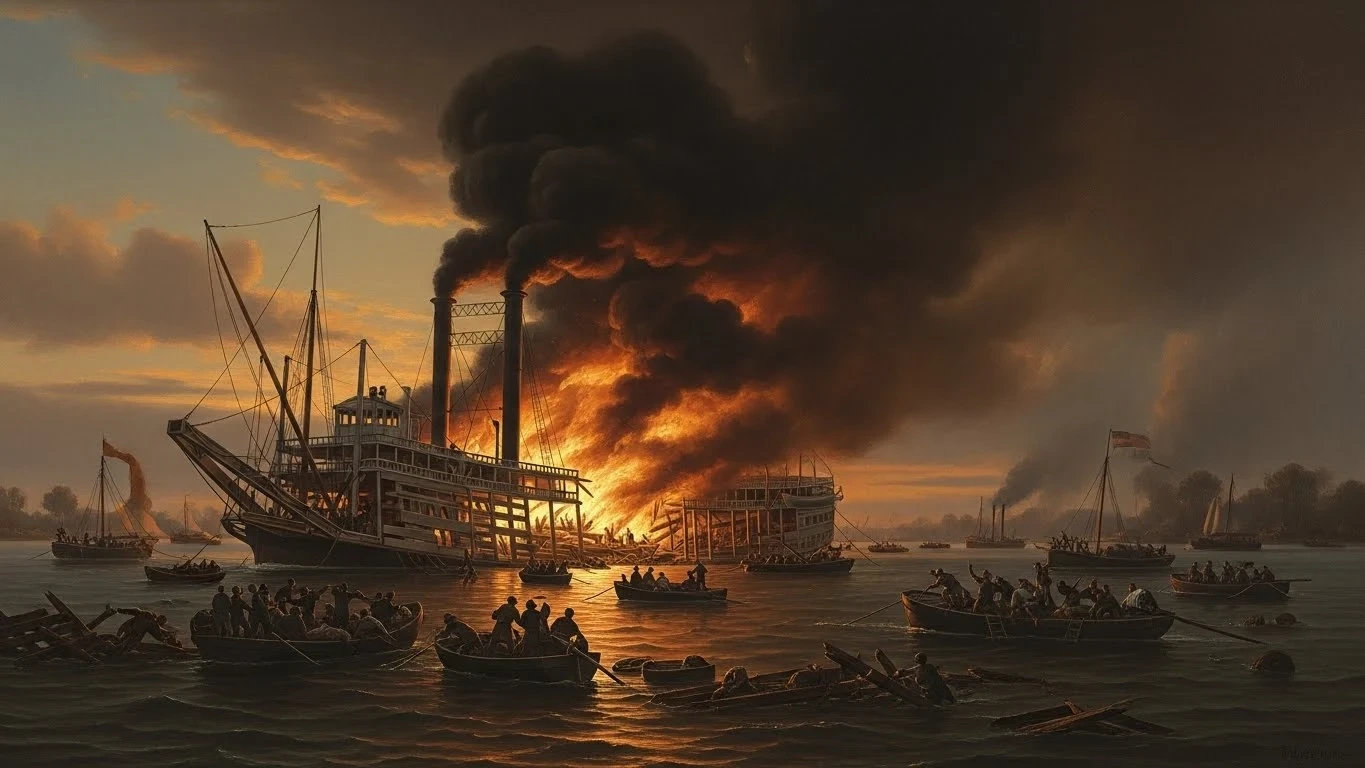
The explosion blasted men into the icy, ink-black water. Instantly, the muddy river became a nightmare soup of flailing limbs, burning wreckage, and desperate screams. Those not killed instantly faced a cruel choice: burn on the hulk or freeze in the flooded April chill. For hours, the Mississippi carried the living and the dead together under an indifferent sky.
A Forgotten Wake: Why the Story Faded
Lost in History’s Shadow
Why is this tragedy not etched into our national memory? As I explore in the final section of my work, the timing created a perfect historical curtain. The nation was utterly consumed by President Lincoln’s assassination and the war’s chaotic end. Additionally, the victims were not civilians, but weary soldiers whose stories seemed like just another part of the war’s terrible toll.
A Story Buried by the Current
Subsequently, official inquiries produced muddled conclusions, and blame diffused among several parties. Finally, the relentless current carried the wreckage away. In this way, the muddy river did more than cause the disaster; it also helped bury the physical evidence and, ultimately, the memory itself.
Heeding the Echoes from the Mud
Ultimately, the Sultana steamboat disaster is more than a historical statistic. It is a profound lesson in the convergence of human fallibility and natural force. It speaks to the enduring cost of corruption, the fragility of life, and the relentless passage of time and water. To let it remain forgotten is to ignore the echoes of those 1,800 souls still whispering from the river’s depths.
If this glimpse into the tragedy has gripped you, I invite you to journey into the heart of the story. In my book, The Muddy River’s Hunger: The Sultana Tragedy, I give names, voices, and homes to the lost. Moreover, I trace the bureaucratic failures, the personal heroisms, and the long shadow cast by that muddy river running. For any student of American history, or for anyone moved by stories of resilience and remembrance, this book is an essential volume. Discover the full, devastating truth of the Sultana. Get your copy today, and help bring this lost chapter of our history back to the surface.
Frequently Asked Questions
What was the Sultana disaster?
The Sultana disaster was the explosion and sinking of the steamboat Sultana on the Mississippi River on April 27, 1865. With an estimated 2,300 people aboard—mostly Union soldiers recently released from Confederate prisons—the death toll of around 1,800 makes it the deadliest maritime disaster in U.S. history.
Why is the Sultana disaster not as well-known as the Titanic?
As author Catherine Howard explains, the tragedy was overshadowed by monumental national events occurring simultaneously, including the assassination of President Abraham Lincoln and the end of the Civil War. The victims were soldiers, and their loss was seen by many as an extension of the war’s terrible toll, leading the story to fade from public memory.
What caused the Sultana to explode?
The direct cause was the catastrophic failure of three of the boat’s four boilers. This was the result of a deadly combination: the boilers were dangerously over-pressurized to navigate the flooded, raging Mississippi River, and they were structurally compromised by a hasty and inadequate repair just before the journey.
Why was the boat so overcrowded?
Greed and wartime bureaucracy were key factors. Captain J. Cass Mason was financially incentivized by a U.S. government contract that paid per soldier transported. He knowingly overloaded the vessel far beyond its legal capacity of 376 passengers to maximize his profit.